I’ve heard senior living compared to college more than a few times over the years, and when you think about it, the similarities are legit. People live in a community surrounded by their peers, gather for meals, participate in activities, develop friendships, explore new interests, and enjoy shared experiences.
Recently, one of my best friends shared a story that brought this comparison to life. His grandmother had moved into an independent living community, and he couldn’t stop talking about how much she was enjoying herself. She was making friends, staying active, and filling her calendar with activities. In fact, he joked that he now needs to book time with her weeks in advance just to see her!
Even he recognized the similarities, describing her new lifestyle as something of a college experience, complete with new friendships, a busy social calendar, and plenty of activities to keep her engaged.
I loved that perspective because it highlights something we sometimes overlook when talking about senior living. Yes, communities provide housing, services, and varying levels of care, but they can also offer something incredibly valuable: connection, purpose, new experiences, and a genuine sense of belonging.
Of course, senior living and college are very different experiences, particularly when care needs enter the picture. But his comment got me thinking about the comparison from a different angle.
If we want people to think about senior living more like college, what could we learn from the way colleges market themselves?
Higher education has spent years developing strategies to attract prospective students, engage parents and families, showcase campus life, and build relationships long before someone enrolls. And when you look at those strategies through the lens of senior living marketing, there are some interesting parallels and opportunities.
So, rather than simply comparing the lifestyles, let’s explore what senior living marketers can learn from higher education’s approach to attracting, engaging, and building relationships with future residents and their families.
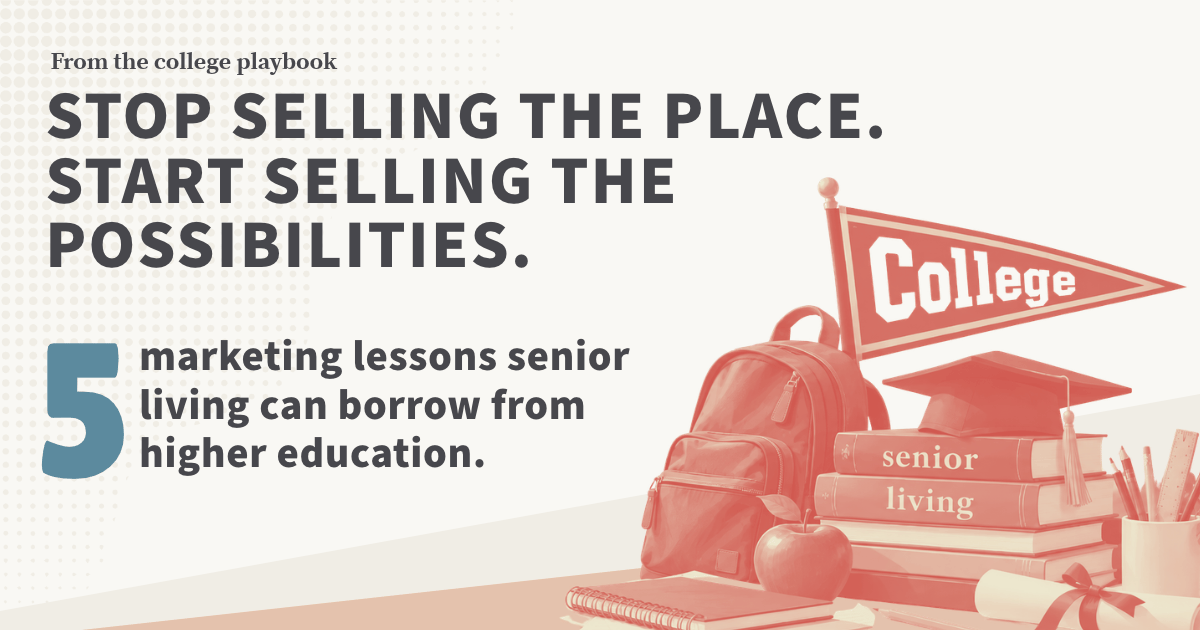
Here are five opportunities worth exploring.
1. Market to the Entire Decision-Making Family
One of the biggest challenges in senior living marketing is understanding who we’re actually marketing to. Is it the prospective resident, their adult children, a spouse, or another family member?
Higher education faces a similar challenge. Colleges market to prospective students while recognizing that parents and families often influence the decision. But they don’t necessarily deliver the same message to everyone.
For students, messaging frequently focuses on friendships, independence, experiences, and future opportunities. For parents, the emphasis may be on safety, academic quality, financial considerations, and career outcomes.
Now consider senior living. A prospective resident might be excited about new friendships, great meals, and fewer responsibilities. Their adult child may be focused on safety, access to care, and financial considerations.
Same community. Different audiences. Different motivations.
The opportunity is to develop messaging that speaks to each audience while keeping the prospective resident at the center of the conversation.
Ideas to Implement
- Create separate website content and educational resources for prospective residents and adult children.
- Segment email campaigns based on audience interests and concerns.
- Train sales teams to identify everyone involved in the decision and personalize their conversations accordingly.
2. Sell the Experience, Not Just the Amenities
Think about the last college commercial you watched. Chances are, you saw students laughing with friends, attending events, participating in activities, or cheering at a sporting event.
You probably didn’t see a lengthy explanation of the square footage of a dorm room.
That’s because colleges understand that prospective students aren’t simply choosing a building. They’re imagining what their lives could look like there.
Now think about senior living marketing. How often do we lead with floor plans, dining rooms, amenities, and lists of services?
Those things matter, but they’re only part of the story.
What if we spent more time showcasing friendships that developed after move-in, residents discovering new interests, or meaningful connections happening around the dinner table?
Rather than simply promoting the activity calendar, show the experiences and relationships those activities create.
The building matters, but the life happening inside the building is what makes it special.
Ideas to Implement
- Create short “Day in the Life” videos featuring authentic resident experiences.
- Turn community activities into stories about friendships, connections, and personal growth.
- Review your website imagery. Are you showcasing empty rooms or people enjoying meaningful experiences?
3. Turn the Community Tour Into an Experience
For many prospective college students, the campus tour is one of the most influential moments in their decision-making process. It’s an opportunity to experience the environment, meet people, and imagine what life might look like.
Colleges often use student ambassadors because they bring authenticity to the experience. They’re not just describing college life. They’re living it.
Now consider the typical senior living tour. We walk through the dining room, show a model apartment, point out the activity spaces, and explain the services.
There’s nothing inherently wrong with that approach, but are we missing an opportunity?
Imagine a prospective resident who loves gardening. Rather than following a predetermined route, why not introduce them to residents who enjoy the community garden? If someone loves playing cards, connect them with the group that meets every Tuesday.
What if our residents played a greater role in the tour experience, much like student ambassadors do for colleges?
The goal shouldn’t simply be to show someone where they could live. It should be to help them imagine the life they could have there.
Ideas to Implement
- Develop a voluntary resident ambassador program to welcome prospective residents.
- Personalize tours around interests, hobbies, and individual preferences.
- Invite prospects to experience a meal, activity, or community event rather than simply touring the building.
4. Build Relationships Long Before Someone Is Ready to Move
Colleges don’t wait until someone is ready to submit an application before introducing themselves. They engage prospective students through educational content, school visits, social media, campus events, and personalized communication.
Over time, those interactions build familiarity and trust.
Senior living has an opportunity to think similarly.
We know that many families don’t begin seriously researching senior living until a significant life event creates an immediate need. But what if communities became trusted resources long before someone needed to move?
Imagine offering educational programs about healthy aging, financial planning, downsizing, caregiving, and maintaining independence. Communities could invite local older adults and their families to participate in events, learn from experts, and connect with others.
The objective wouldn’t be to push someone toward a move before they’re ready. It would be to provide value and build relationships so that when the time comes, they already know who you are.
This connects directly to something I’m passionate about: Create value before asking for the sale.
Ideas to Implement
- Host monthly educational events for older adults and their families.
- Develop email nurturing campaigns focused on helpful resources rather than repeated sales follow-ups.
- Partner with local experts and organizations to become a trusted source of information in your community.
5. Make Belonging Part of the Brand Promise
One of the most compelling messages in higher education marketing is the idea of belonging. Colleges want prospective students to see themselves as part of something bigger: a community, a tradition, and a shared experience.
Senior living has an opportunity to communicate that same sense of belonging.
We frequently talk about combating loneliness and social isolation among older adults. But what if we shifted more of our messaging toward the opportunities that come from being part of a community?
New friendships, shared meals, meaningful conversations, opportunities to learn, and experiences that bring people together are all powerful parts of the senior living story.
Of course, belonging looks different for everyone. Some people enjoy group activities and a full social calendar, while others prefer smaller gatherings and quieter experiences. Our marketing should reflect that variety.
And most importantly, the experience we’re marketing must reflect what residents actually experience every day.
Belonging isn’t something we can simply promise in an advertisement. It’s something communities have to create.
Ideas to Implement
- Share resident stories highlighting meaningful friendships and connections.
- Create opportunities for future residents to build relationships before move-in.
- Collaborate with life enrichment, dining, and operations teams to identify authentic stories worth sharing.
What If We Started Marketing Senior Living Differently?
I don’t believe senior living should simply copy the higher education marketing playbook. The decision to move into senior living is often more complex, emotional, and time-sensitive than choosing a college.
But there are valuable lessons in how colleges approach the customer journey.
They understand the importance of marketing to multiple audiences, creating emotional connections, showcasing experiences, building relationships over time, and helping prospective students envision their future.
And the good news? Many of these ideas don’t require significant marketing budgets. They require collaboration, creativity, and a willingness to look at the customer journey differently.
Perhaps the biggest opportunity is to shift our focus from simply marketing where someone will live to helping them envision the life they could live.
Because when you think about what makes college memorable, it usually isn’t the dorm room, the cafeteria, or even the classroom.
It’s the people we met, the friendships we developed, the experiences we shared, and the memories we created.
And isn’t that what we want senior living to be about, too?